AnyNet® for SGP.32
Intelligent Connectivity.
Built to evolve.
Built to evolve.
Deploy globally, connect locally and stay in control. AnyNet® brings together extensive SGP.32 profile choice, intelligent orchestration and resilient global connectivity, with the flexibility on how its managed.


MORE CHOICE. MORE TO MANAGE.
SGP.32 gives you greater choice.
But who manages the complexity?
SGP.32 can help can extend your connectivity options, but it transfers commercial, technical and operational responsibility to your team.
Multiple contracts
Who will negotiate, manage and renew separate agreements with each profile provider?
Multiple bills

Can you reconcile different tariffs, currencies, usage records and billing cycles?
Profile decisions
Who selects the right profile as coverage, cost and regulatory requirements change?
Fragmented support

Who owns the issue when the device, profile, network and operator are all involved?
Different infrastructure

Can you manage different APNs, routing, security and integration environments?
Service continuity

What happens if a profile download or switch fails and the device loses connectivity?
INTRODUCING ANYNET® SGP.32
SGP.32 flexibility.
Without the operational complexity.
One flexible ecosystem bringing together profile choice, intelligent orchestration and resilient global connectivity.
More profile choice

Access an unrivalled range of multi-IMSI, local and regional operator profiles.
Built-in resilience

Retain bootstrap and fallback connectivity to support delivery, recovery and device reachability.
Your operating model

Choose managed or self-service control, combine approaches and transition as your IoT project needs evolve.
One profile ecosystem.
Your choice of how to operate.
Choose the level of service and control that suits your business today, with the flexibility to combine and evolve as your deployment and requirements change.
FULLY MANAGED
AnyNet® Managed Service

Management of profile selection, access to multi-IMSI profile, provisioning, monitoring, network infrastructure, billing and support, with end-to-end accountability.
Best for: Enterprises needing operational simplicity and end-to-end accountability.
SELF-SERVICE PROFILES
AnyNet® Select

Select and manage your profiles through Infinity or via API, providing additional local and regional connectivity options where needed.
Best for: Enterprises, MNOs and MVNOs that need greater choice of local and regional profiles to meet specific market and localisation requirements.
Explore AnyNet® SelectTHIRD-PARTY PROFILES
Bring existing relationships with you

Use Infinity to orchestrate third-party SGP.32 profiles across multiple eIMs, while retaining your existing connectivity relationships.
Best for: Enterprises that want to keep their existing operator relationships and profiles, while managing them centrally through Infinity.
Unlock the full flexibility of SGP.32
Combine resilient bootstrap and fallback connectivity with downloadable local, regional and 3rd-party profiles.
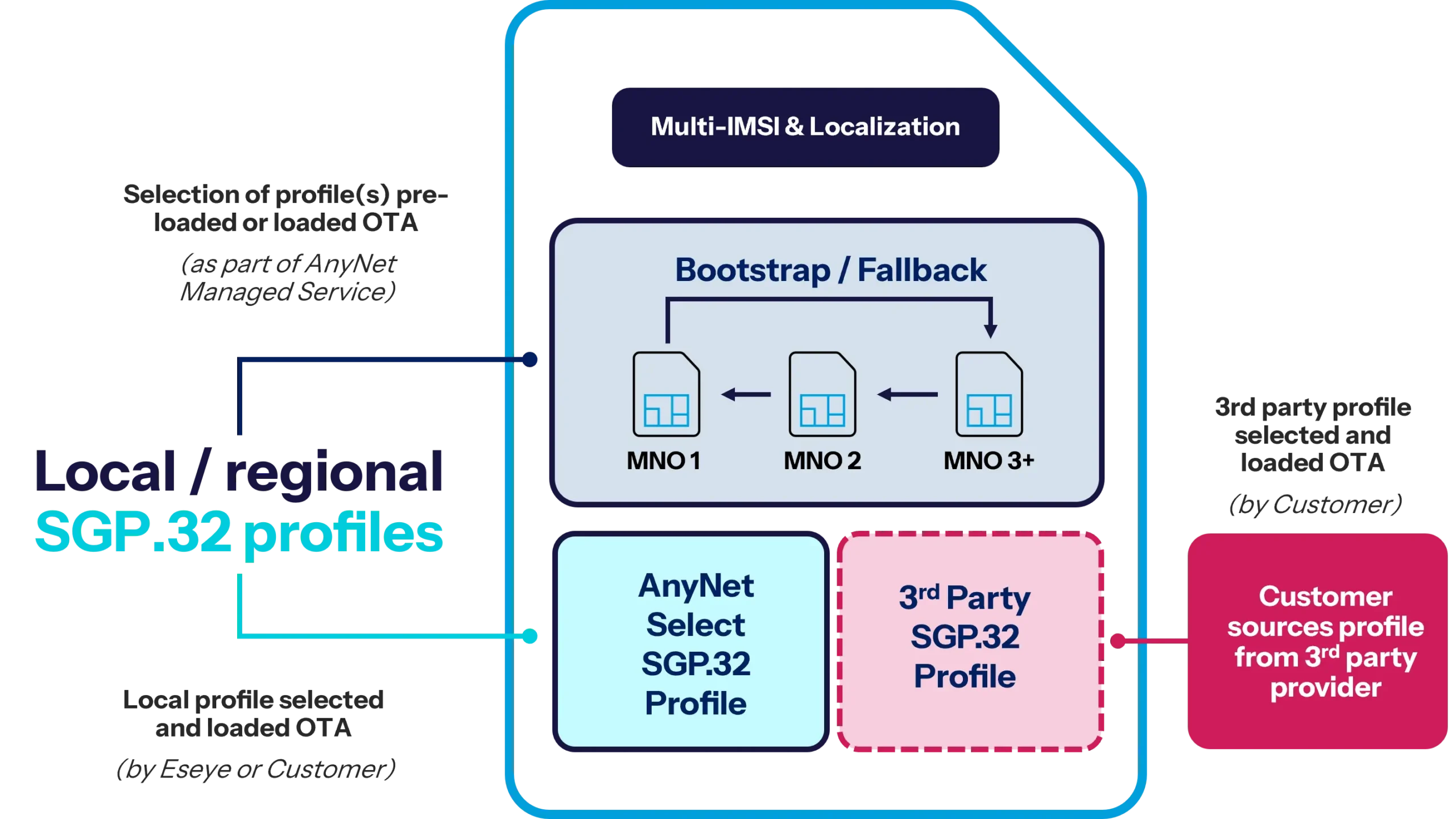
Bootstrap / Fallback
Selection of profile(s) pre-loaded or loaded OTA
(as part of AnyNet Managed Service)
AnyNet Select SGP.32 Profile
Local profile selected and loaded OTA
(by Eseye or Customer)
3rd Party SGP.32 Profile
3rd party profile selected and loaded OTA
(by Customer)
Dive-deeper
into SGP.32
Deep-dive into Eseye’s SGP.32 proposition, its
alignment with existing RSP standards, and the broader
implications for enterprises looking to future-proof their
IoT strategies.
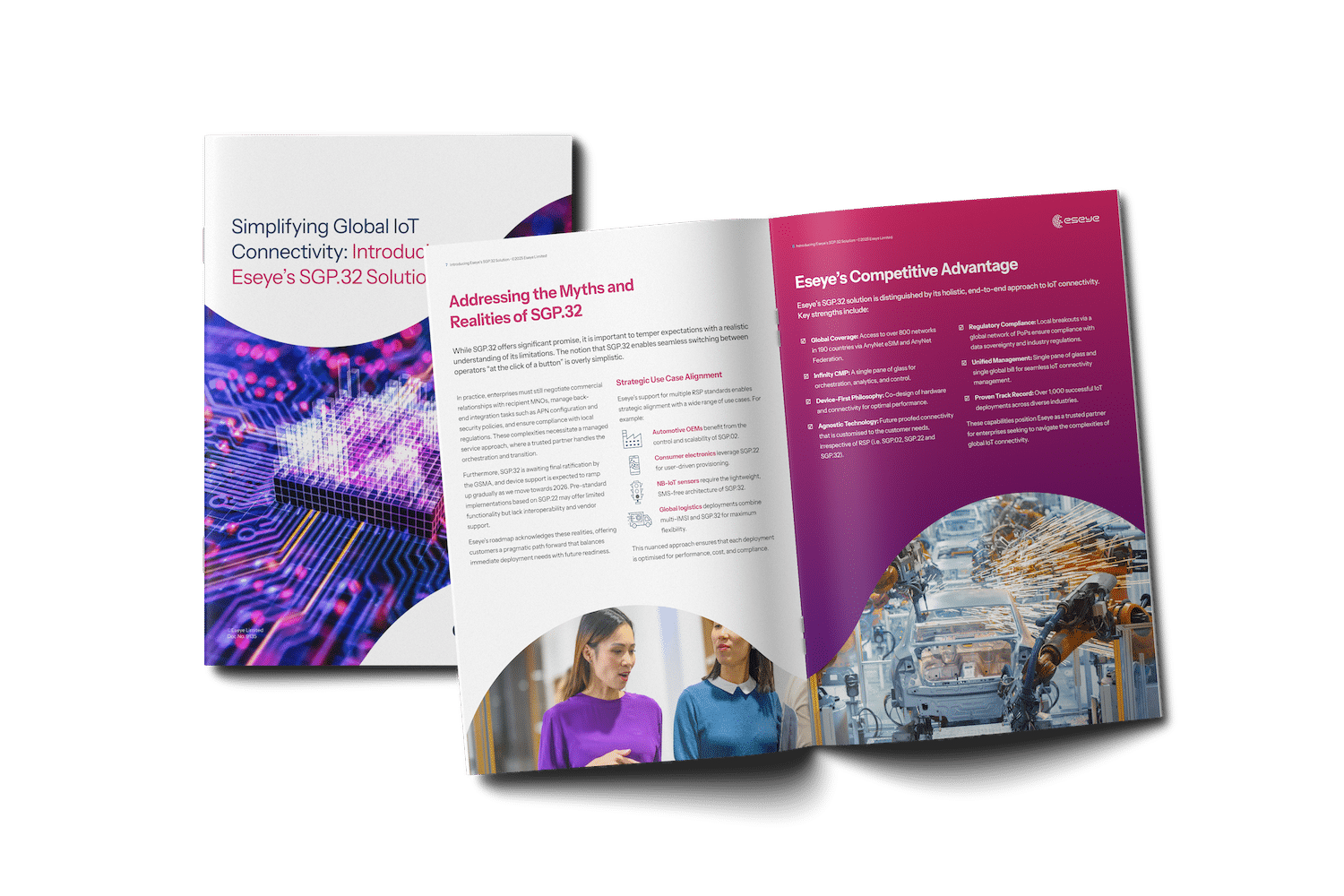

Unified global IoT orchestration
Our approach
to SGP.32
SGP.32 is most powerful as part of a broader connectivity strategy. Eseye brings SGP.32 together with existing RSP standards, global connectivity and advanced orchestration to create a flexible foundation for evolving IoT deployments.
Platform agnostic
+ customer-centric

One framework. More choice.
Supports SGP.02, SGP.22 and SGP.32 within a flexible orchestration framework, combining Eseye connectivity with an extensive choice of local, regional and multi-IMSI profiles to meet different deployment requirements.
Global deployment
with local connectivity

Localise connectivity as needs evolve.
Start with resilient bootstrap connectivity, then select and download the right local or regional profile as requirements evolve. SGP.32 simplifies remote profile management while helping maintain connectivity throughout the device lifecycle.
Advanced
eSIM orchestration

Turn profile choice into intelligent action.
Infinity coordinates profile selection, download and enablement through configurable policies based on location, coverage, cost, regulation and network availability.
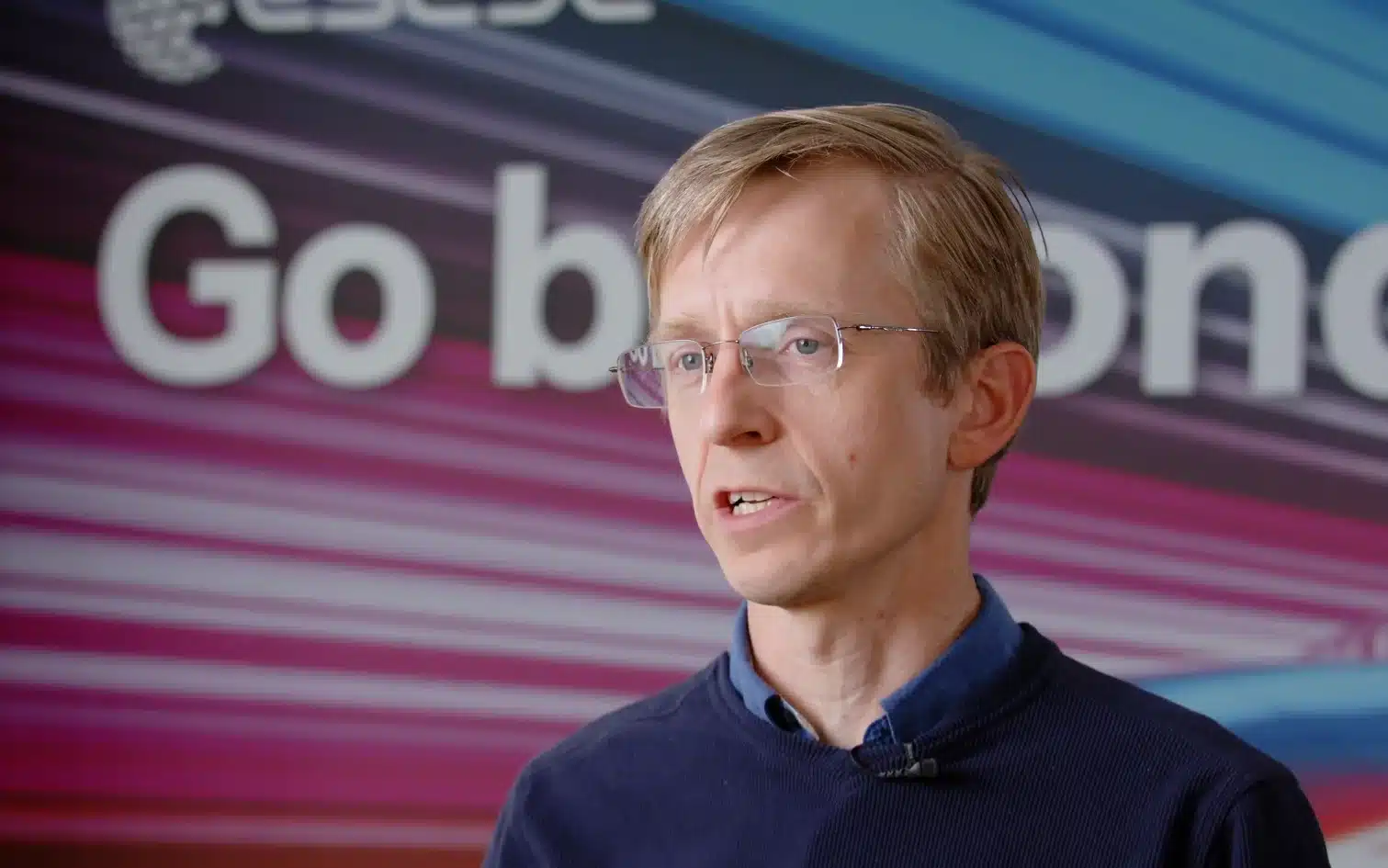
Future-proof your IoT Deployments
How Eseye integrates SGP.32
Eseye’s CTO Ian Marsden explains how SGP.32 will impact IoT and how Eseye integrates SGP.32 into its existing suite of solutions, including the AnyNet+ eSIM and the Infinity Connectivity Management Platform, supporting SGP.02, SGP.22, and SGP.32 within a single orchestration framework.
Why choose Eseye
for SGP.32
Deploy globally, connect locally and stay in control. AnyNet® for SGP.32 combines extensive profile choice, intelligent orchestration and resilient global connectivity, with the flexibility to let Eseye manage it for you or take control yourself.
01Multi-RSP support
One framework for SGP.02, SGP.22 and SGP.32
Support existing and next-generation IoT deployments through a single orchestration framework.
02Extensive profile choice
Global reach with local connectivity
Access a growing choice of local, regional and multi-IMSI SGP.32 profiles to meet your deployment needs.
03Intelligent orchestration
The right connectivity, at the right time
Select and orchestrate profiles based on location, coverage, cost, regulation and network availability.
04Resilience built in
Stay connected through change
Bootstrap and fallback connectivity help maintain device reachability during profile delivery, switching and recovery.
05One consistent experience
Change profiles, not your infrastructure
Maintain a common APN, one API and Eseye’s global private-network environment across supported AnyNet profiles.
06Your choice of control
Managed by Eseye or controlled by you
Choose a fully managed service, manage profiles yourself through Infinity, or integrate profile management into your own systems via API.
Start your
SGP.32 journey today
For enterprises embarking on their IoT journey, the message is clear: don’t select a technology in isolation.
Instead, choose a partner that offers a continuum of capabilities, a roadmap for migration, and the technical expertise to deliver success.
Get in touch
Common questions about SGP.32 and deployment
SGP .32 FAQ
What is SGP.32?
SGP.32 is the new GSMA RSP standard for IoT eSIM / eUICC, designed specifically for the Internet of Things. It combines the benefits of earlier eSIM/M2M /consumer eSIM standards (like SGP.02 and SGP.22) to enable remote control of operator profiles without requiring physical SIM swaps or user interaction.
Is Eseye already offering SGP.32 solutions?
Yes. Eseye has integrated SGP.32 into its proven AnyNet+ eSIM and Infinity Connectivity Management Platform, giving enterprises unified control and choice across all RSP models (SGP.02, SGP.22, and SGP.32) from a single interface for simpler global IoT logistics.
Unlike many SGP.32 implementations that rely on a single operator profile, Eseye combines SGP.32 with its AnyNet+ multi-IMSI architecture to deliver resilient global connectivity.
What does “transitioning to SGP.32” involve? What do I need to do?
SGP.32 requires a new SIM and is not backward compatible with earlier standards. Migration from existing deployments typically occurs during device refresh cycles and requires a physical SIM swap, rather than through a simple over-the-air upgrade.
Here are some of the things enterprises need to consider:
- Ensure your hardware / devices support eUICC and required protocols (e.g. remote profile download, BIP or similar over-the-air management).
- Validate that your current modems/firmware can handle OTA profile switching.
- Plan for updating device firmware if needed.
- Map out which operators / networks you’ll need in each region and is a SGP.32 profile available to support connectivity there.
- Consider how fallback / bootstrap profiles will work.
- Work with Eseye’s experts / technical support to get guidance and help. Eseye offers services such as a free device assessment to test readiness.
When should I consider moving over to an SGP.32 solution?
- Is your device SGP.32 ready within your device and application environment?
- Are there enough profiles available? A sufficient number of Mobile Network Operators (MNOs) must have IoT profiles available for localisation, enabling practical deployment at scale.
- In most cases, SGP.32 requires a new SIM (eUICC). However, if your existing device already contains an SGP.32-capable eUICC, migration may be possible without replacing the hardware and you may be able to migrate without hardware changes (refer to one of Eseye’s IoT Specialists for more information).
However, devices that only support older SIM standards or that lack remote profile management, hardware
replacement or upgrade will be required.
How does Eseye ensure connectivity continuity / fallback?
Eseye’s Infinity Platform supports managed switching across many mobile networks (800+ networks in 190+ countries) using eSIM orchestration. The infrastructure is designed to allow automatic / remote switching to maintain connectivity, even if a primary operator profile fails. This minimizes downtime for globally deployed IoT devices.
What are the benefits of moving to SGP.32?
Some of the key benefits that SGP.32 offers are:
- Ship one SKU globally (no multiple region-specific SIM types)
- Lower logistics and manufacturing complexity
- Remote profile management: add/remove/switch operator profiles without physical intervention
- Bring Your Own Carrier (BYOC) if you have an existing arrangement and access to a profile
- Improved flexibility and faster deployment in new regions
- Better resilience through fallback / bootstrap profiles.
Are there any compatibility issues / constraints?
Yes, potential constraints include:
- Device modems / firmware must support eUICC and remote profile management protocols.
- Some existing older devices may not be upgradable to full SGP.32 compatibility.
- You may need to test OTA functionality, firmware behaviour, and edge cases (e.g. network transitions, roaming, profile switching) in your own deployment scenario.
- Your device must use a global APN, not one tied to a specific operator. If not, you must be able to remotely update the APN on the device. Eseye solves this by offering a global APN that works across all its partner networks in the AnyNet Federation.
Can I select the carrier I want?
Eseye offers a managed service to simplify everything to do with connectivity. We will work with you to ensure the correct carrier and fallback options are selected. If you have an existing carrier profile and agreement that you would like to use in addition, this can be explored with one of our IoT Specialists.
Does using an alternative or fallback profile incur extra cost?
This depends on your provider and plan terms. Whichever profile you’re using is highly likely to incur an additional cost.
We recommend getting in touch to discuss your particular use case.
What support does Eseye provide to help with SGP.32 migration?
To provide help with SGP.32 migration, Eseye offers:
- SGP.32 ready SIMs.
- Free device assessments to test your hardware readiness.
- Technical documentation and guidance.
- Whitepapers and resources: “Adopting SGP.32: What Enterprises Need to Know” for planning.
- Customer support and expert consultations.
Does SGP.32 guarantee connectivity across all networks?
No. SGP.32 enables profiles to be downloaded remotely, but connectivity still depends on the underlying network and roaming agreements. Many implementations rely on a single operator profile at a time, which can introduce coverage limitations.
Eseye addresses this by combining SGP.32 with multi-IMSI connectivity, enabling access to multiple networks for greater resilience.
Is SGP.32 enough on its own for global IoT connectivity?
No. SGP.32 defines how profiles are delivered to a SIM, but it does not address the full complexity of global IoT connectivity. Enterprises must still manage operator relationships, billing, compliance, and device behaviour.
For this reason, SGP.32 is typically used as part of a broader orchestration and managed connectivity solution.
What happens if a network fails in an SGP.32 deployment?
In many SGP.32 implementations, connectivity depends on a single operator profile. If that network experiences issues, the device may lose connectivity until a new profile is deployed. Eseye mitigates this risk by combining SGP.32 with its AnyNet+ multi-IMSI architecture, enabling devices to maintain connectivity across multiple networks and automatically recover from outages.
Why combine SGP.32 with multi-IMSI?
SGP.32 enables remote profile management, while multi-IMSI provides real-time access to multiple network identities. Combining both allows enterprises to benefit from flexible profile provisioning and resilient connectivity.
This approach ensures devices remain connected even in complex or changing network conditions.
Can SGP.32 reduce operational complexity?
SGP.32 can simplify certain aspects of profile delivery, particularly for constrained devices. However, it does not remove the need to manage connectivity operations such as billing, configuration, and compliance.
Without orchestration, SGP.32 can introduce additional operational complexity. This is why many organisations adopt it as part of a managed service.
How does Eseye orchestrate SGP.02 and SGP.32 connectivity?
A simplified view of how Eseye orchestrates SGP.32 connectivity in practice. The numbered steps match the architecture diagram below.
- Device ready – Devices are equipped with eSIM and IoT Profile Assistant (IPA).
- Profile request – Profiles are requested dynamically based on policy and device needs.
- Secure preparation – Profiles are securely prepared and encrypted via SM-DP+.
- Profile download – Profiles are delivered and installed onto the device eUICC.
- Activation & management – Profiles are activated and managed throughout their lifecycle.
- Eseye orchestration layer – Eseye unifies SGP.02 and SGP.32 environments, orchestrating profiles, policies, and lifecycle management across global device estates.
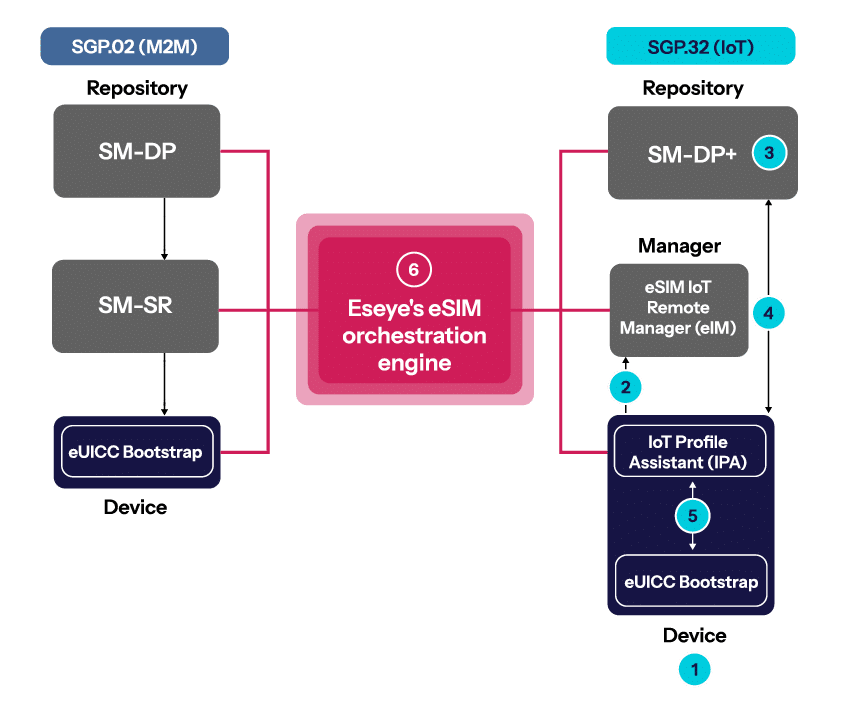
Eseye connects device provisioning, profile orchestration and lifecycle management through one platform. Click the diagram to enlarge.