Device ready
1
Devices are equipped with eSIM and IoT Profile Assistant (IPA).



Unlock global IoT scalability with a single eSIM orchestration platform that supports SGP.02, SGP.22, and SGP.32.


The landscape of cellular IoT connectivity is undergoing a profound transformation. At the heart of this evolution is SGP.32, the latest Remote SIM Provisioning (RSP) standard developed by the GSMA, designed specifically to support constrained IoT devices and overcome the limitations of earlier standards.
Designed specifically
for IoT

SGP.32 addresses many of the limitations of its predecessors, SGP.02 / SGP.22 and introduces a new architecture designed to better support constrained IoT devices.
The evolution of Remote SIM Provisioning
Remote SIM Provisioning has revolutionised how enterprises manage cellular connectivity. From removable SIM cards to eSIM and iSIM, new mechanisms were required to manage SIM profiles remotely.
A hybrid approach for modern IoT environments

SGP.32 builds on these foundations, offering a hybrid approach that combines remote orchestration with lightweight protocols, making it ideal for constrained IoT environments.
A simplified view of how Eseye orchestrates SGP.32 connectivity in practice. The numbered steps below align directly with the architecture diagram.
Devices are equipped with eSIM and IoT Profile Assistant (IPA).
Profiles are requested dynamically based on policy and device needs.
Profiles are securely prepared and encrypted via SM-DP+.
Profiles are delivered and installed onto the device eUICC.
Profiles are activated and managed throughout their lifecycle.
Eseye unifies SGP.02 and SGP.32 environments, orchestrating profiles, policies, and lifecycle management across global device estates.

The diagram shows how Eseye connects device provisioning, profile orchestration,
and lifecycle management through a unified platform.
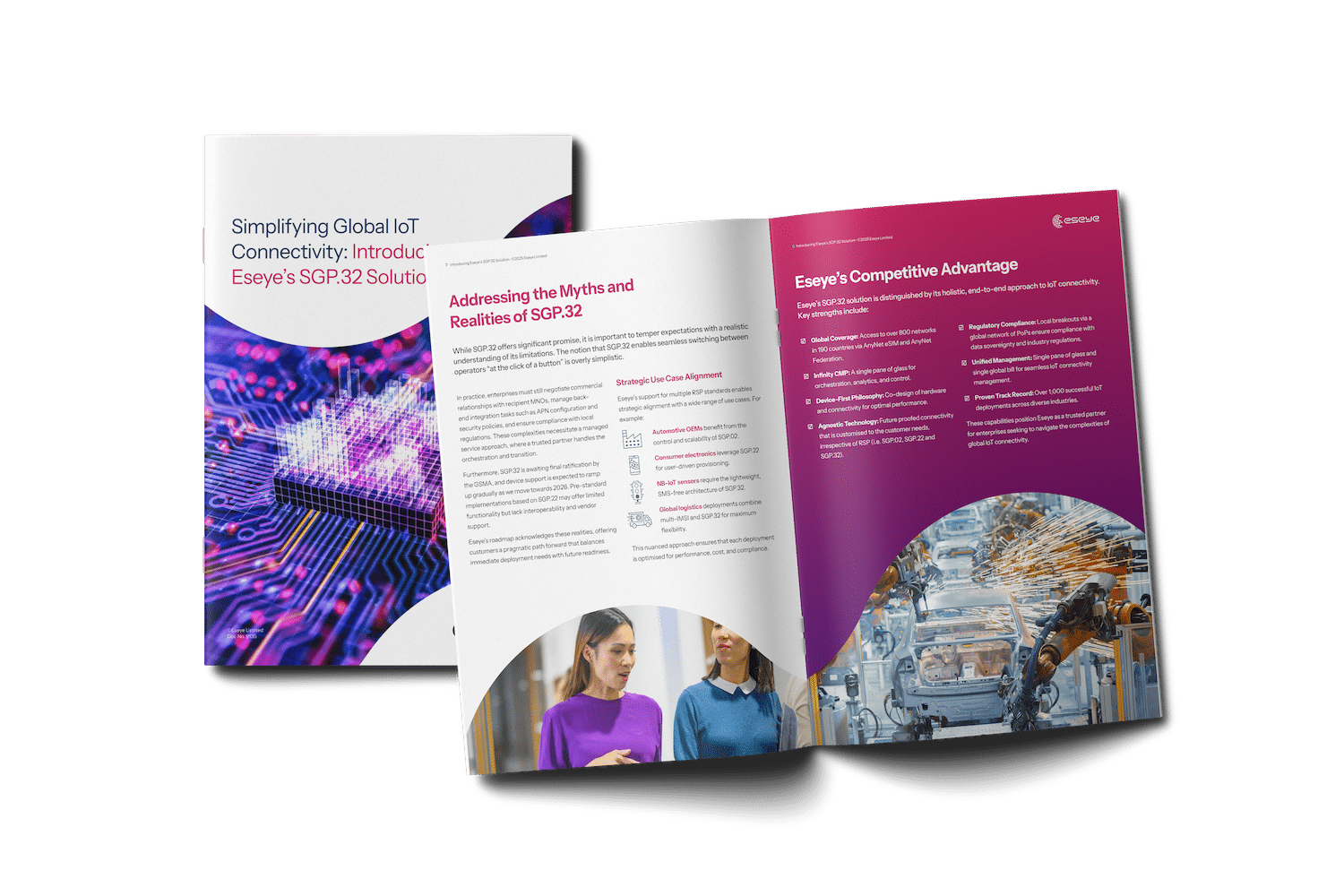
Deep-dive into Eseye’s SGP.32 proposition, its
alignment with existing RSP standards, and the broader
implications for enterprises looking to future-proof their
IoT strategies.
Our approach is grounded in the belief that SGP.32 should be part of a broader orchestration framework that abstracts complexity and delivers seamless connectivity.
Platform agnostic +
customer-centric

Eseye’s patented multi-IMSI approach, combined with platform-agnostic support for multiple RSP standards, reduces complexity, enables multi-country flexibility, and delivers tailored connectivity strategies.
SGP.32
technical advantages
Enabling remote UI control via eIM, uses CoAP/LwM2M for lightweight communication, removes SMS dependency, reduces device footprint, and integrates into managed connectivity orchestration frameworks.
Solidifying the role of the
eSIM Orchestrator
The eSIM Orchestrator (eSO), manages profile lifecycle, network and device awareness, compliance, billing, and support, with Eseye’s Infinity platform delivering unified orchestration capabilities.

Eseye’s CTO Ian Marsden explains how SGP.32 will impact IoT and how Eseye integrates SGP.32 into its existing suite of solutions, including the AnyNet+ eSIM and the Infinity Connectivity Management Platform, supporting SGP.02, SGP.22, and SGP.32 within a single orchestration framework.
Eseye’s differentiation lies in supporting SGP.32, SGP.02 and SGP.22 within a single platform, combined with global network resilience, multi-operator orchestration, and a fully managed connectivity service.
Supports SGP.02, SGP.22, and SGP.32 within a single orchestration framework
Future proofed connectivity customised to customer needs, irrespective of RSP (i.e. SGP.02, SGP.22 and SGP.32)
Achieve close to 100% uptime across 800+ networks in over 190 countries
Enabled by advanced multi-IMSI, eUICC eSIM and intelligent network switching.
Fully managed connectivity with devices connected 24/7
Keeping devices connected continuously through a fully managed service.

Built-in support for regional compliance
Delivered through local breakouts via a global network of PoPs.

A single pane of glass for orchestration, analytics, and control
Combined with unified management and a single global bill for seamless IoT connectivity.
Over 1,000 successful IoT deployments across diverse industries
A proven track record with over 1,000 successful IoT deployments across diverse industries positions Eseye as a trusted partner for global IoT connectivity.
For enterprises embarking on their IoT journey, the message is clear: don’t select a technology in isolation.
Instead, choose a partner that offers a continuum of capabilities, a roadmap for migration, and the technical expertise to deliver success.
What is SGP.32?
SGP.32 is the new GSMA RSP standard for IoT eSIM / eUICC, designed specifically for the Internet of Things. It combines the benefits of earlier eSIM/M2M /consumer eSIM standards (like SGP.02 and SGP.22) to enable remote control of operator profiles without requiring physical SIM swaps or user interaction.
Is Eseye already offering SGP.32 solutions?
Yes. Eseye has integrated SGP.32 into its proven AnyNet+ eSIM and Infinity Connectivity Management Platform, giving enterprises unified control and choice across all RSP models (SGP.02, SGP.22, and SGP.32) from a single interface for simpler global IoT logistics.
Unlike many SGP.32 implementations that rely on a single operator profile, Eseye combines SGP.32 with its AnyNet+ multi-IMSI architecture to deliver resilient global connectivity.
What does “transitioning to SGP.32” involve? What do I need to do?
SGP.32 requires a new SIM and is not backward compatible with earlier standards. Migration from existing deployments typically occurs during device refresh cycles and requires a physical SIM swap, rather than through a simple over-the-air upgrade.
Here are some of the things enterprises need to consider:
When should I consider moving over to an SGP.32 solution?
However, devices that only support older SIM standards or that lack remote profile management, hardware
replacement or upgrade will be required.
How does Eseye ensure connectivity continuity / fallback?
Eseye’s Infinity Platform supports managed switching across many mobile networks (800+ networks in 190+ countries) using eSIM orchestration. The infrastructure is designed to allow automatic / remote switching to maintain connectivity, even if a primary operator profile fails. This minimizes downtime for globally deployed IoT devices.
What are the benefits of moving to SGP.32?
Some of the key benefits that SGP.32 offers are:
Are there any compatibility issues / constraints?
Yes, potential constraints include:
Can I select the carrier I want?
Eseye offers a managed service to simplify everything to do with connectivity. We will work with you to ensure the correct carrier and fallback options are selected. If you have an existing carrier profile and agreement that you would like to use in addition, this can be explored with one of our IoT Specialists.
Does using an alternative or fallback profile incur extra cost?
This depends on your provider and plan terms. Whichever profile you’re using is highly likely to incur an additional cost.
We recommend getting in touch to discuss your particular use case.
What support does Eseye provide to help with SGP.32 migration?
To provide help with SGP.32 migration, Eseye offers:
Does SGP.32 guarantee connectivity across all networks?
No. SGP.32 enables profiles to be downloaded remotely, but connectivity still depends on the underlying network and roaming agreements. Many implementations rely on a single operator profile at a time, which can introduce coverage limitations.
Eseye addresses this by combining SGP.32 with multi-IMSI connectivity, enabling access to multiple networks for greater resilience.
Is SGP.32 enough on its own for global IoT connectivity?
No. SGP.32 defines how profiles are delivered to a SIM, but it does not address the full complexity of global IoT connectivity. Enterprises must still manage operator relationships, billing, compliance, and device behaviour.
For this reason, SGP.32 is typically used as part of a broader orchestration and managed connectivity solution.
What happens if a network fails in an SGP.32 deployment?
In many SGP.32 implementations, connectivity depends on a single operator profile. If that network experiences issues, the device may lose connectivity until a new profile is deployed. Eseye mitigates this risk by combining SGP.32 with its AnyNet+ multi-IMSI architecture, enabling devices to maintain connectivity across multiple networks and automatically recover from outages.
Why combine SGP.32 with multi-IMSI?
SGP.32 enables remote profile management, while multi-IMSI provides real-time access to multiple network identities. Combining both allows enterprises to benefit from flexible profile provisioning and resilient connectivity.
This approach ensures devices remain connected even in complex or changing network conditions.
Can SGP.32 reduce operational complexity?
SGP.32 can simplify certain aspects of profile delivery, particularly for constrained devices. However, it does not remove the need to manage connectivity operations such as billing, configuration, and compliance.
Without orchestration, SGP.32 can introduce additional operational complexity. This is why many organisations adopt it as part of a managed service.