

Eseye has been recognised in the latest Connectivity Infrastructure Report from Kaleido Intelligence, an analyst assessment examining how IoT connectivity providers are building resilient, sovereign and flexible network infrastructures for global deployments.
As enterprise IoT deployments grow in scale and complexity, the expectations placed on connectivity infrastructure have evolved. Organisations now require high availability, intelligent traffic management, regional data sovereignty and support for emerging workloads such as edge AI.
Kaleido Intelligence’s latest research evaluates how connectivity providers are addressing these requirements through their core network architecture and infrastructure design.
In its profile of Eseye, Steffen Sorrell, Chief of Research at Kaleido Intelligence noted:
"Eseye reported one of the highest number of PoP locations worldwide which it couples with high availability mechanisms that are backed by customer SLAs. Multiple MNO core networks support resilience, although this type of approach was outside the scope of this analysis. The solution highlighted strong flexibility in terms of deployment options, and core capabilities to address enterprise edge AI workloads are already in place."
The full analysis is available in Kaleido Intelligence’s “Perspectives: Networks for IoT” report.
Positioning in the connectivity infrastructure landscape
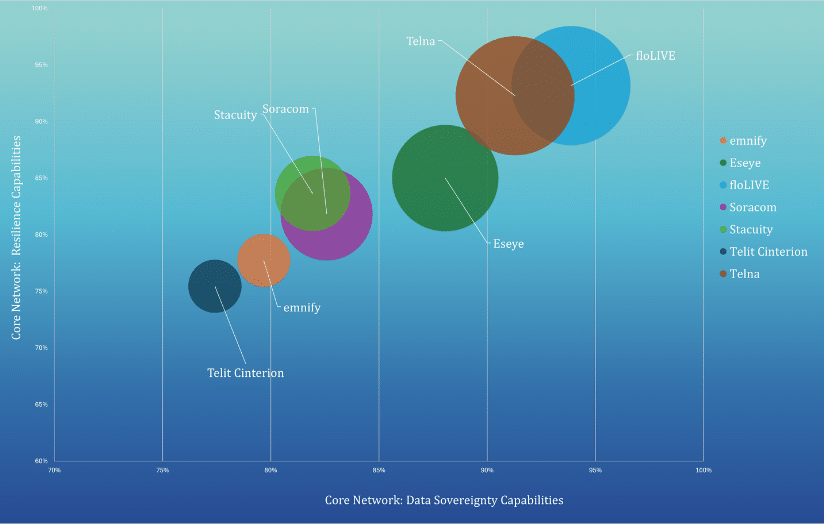
As part of the report, Kaleido Intelligence produced a market positioning chart (see above) comparing leading IoT connectivity providers based on two key capabilities:
- Core Network Resilience
- Data Sovereignty Capabilities
Eseye is positioned strongly within the upper-right quadrant of the chart, reflecting its ability to deliver both resilient connectivity infrastructure and flexible regional data routing.
The chart highlights how providers differentiate in their approach to building IoT network infrastructure. Some focus primarily on global reach, while others emphasise cloud-native deployment or regional data control.
Eseye’s position reflects a strategy built around distributed architecture, multiple core network integrations and regional Points of Presence (PoPs) that enable both resilience and data sovereignty.
Building resilience into IoT connectivity infrastructure
Resilience is fundamental to enterprise IoT deployments. Devices are often distributed across multiple countries and networks, operating in environments where connectivity disruptions can directly affect operations.
Eseye’s Infinity and Integra connectivity platforms designed to minimise these risks through redundancy, distributed infrastructure and automated failover mechanisms.
Eseye operates a global SDN/MPLS network spanning 15 regional Points of Presence (PoPs) that provide local breakout and regional traffic termination. This distributed architecture allows data to remain within specific geographic regions where required, helping enterprises address regulatory and data sovereignty requirements.
The infrastructure is designed with paired PoPs and built-in redundancy, enabling traffic to automatically fail over between gateways if a network path becomes unavailable. This ensures connectivity remains uninterrupted even during maintenance events or unexpected disruptions.
This distributed architecture helps enterprises maintain reliable connectivity across global IoT deployments while ensuring regional resilience.
A multi-core strategy for global IoT deployments
Another defining aspect of Eseye’s infrastructure is its multi-core connectivity approach.
Rather than relying on a single mobile core network, Eseye integrates multiple mobile network operator (MNO) cores alongside its own core infrastructure.
This design provides multiple paths for connectivity and enables devices to operate across diverse network environments.
For enterprise deployments, this delivers several important benefits:
- Greater resilience, with connectivity maintained even if one network path experiences issues
- Improved operational continuity during network maintenance or infrastructure events
- Flexibility for global deployments, supporting devices across multiple operators and regions
Where required, donor IMSIs can be mapped across diverse interconnects and PoPs to ensure sessions can fail over between packet gateways without service interruption.
This approach aligns with the broader industry shift away from single-core connectivity architectures towards multi-core and multi-network designs that prioritise resilience and flexibility.
Cloud-native architecture and deployment flexibility
Enterprise IoT infrastructure must also support a variety of deployment models, including public cloud, private infrastructure and edge environments.
Eseye’s platform is designed with this flexibility in mind. Core network components can be deployed in cloud or hybrid models, with management systems and the connectivity management platform operating across multiple AWS regions, while data-plane functions typically run within private PoP data centres.
The architecture is built using containerised microservices orchestrated through Kubernetes, a cloud-native platform that allows network functions to scale independently while maintaining high availability.
This cloud-native approach enables faster scaling, improved resilience and the ability to introduce new services without significant infrastructure changes.
Intelligent routing and connectivity optimisation

As IoT deployments grow, enterprises increasingly require control over how data flows across their connectivity infrastructure.
Eseye supports policy-driven traffic steering, allowing routing decisions to be automated based on network performance metrics, device context and operational policies.
Traffic can be routed based on factors such as:
- Device location
- APN configuration
- Application requirements
- Enterprise-defined policies
Flexible packet gateway selection and local breakout capabilities allow traffic to be routed efficiently without requiring core software upgrades.
This level of control helps enterprises optimise connectivity performance while maintaining compliance with regional data policies.
Observability and operational insight
Visibility into device behaviour and network performance is essential for managing large-scale IoT deployments.
Eseye provides telemetry and monitoring capabilities that expose key performance metrics including:
- Device registration success rates
- Session counts and throughput
- Network latency and capacity trends
These insights are delivered through dashboards and APIs and can be integrated into enterprise analytics environments. Telemetry sources include packet traces, NetFlow and signalling interfaces.
Operational audit logs are also maintained to support compliance requirements, with records retained according to enterprise data retention policies.
Enabling the next generation of IoT workloads
As IoT applications become more sophisticated, connectivity infrastructure must evolve to support new workloads.
Applications such as edge AI, distributed analytics and real-time automation place new demands on connectivity networks, requiring low latency, regional processing and highly resilient architectures.
The Kaleido Intelligence report highlights that the core capabilities required to support these emerging workloads are already present within Eseye’s connectivity infrastructure.
As organisations scale their IoT deployments globally, infrastructure that combines resilience, data sovereignty and operational visibility will be critical to supporting the next generation of connected solutions.
Talk to our experts to see how Eseye’s multi-core connectivity infrastructure
can improve resilience and performance in your IoT deployments.

Eseye brings decades of end-to-end expertise to integrate and optimise IoT connectivity delivering near 100% uptime. From idea to implementation and beyond, we deliver lasting value from IoT. Nobody does IoT better.
In this article
- Positioning in the connectivity infrastructure landscape
- Building resilience into IoT connectivity infrastructure
- A multi-core strategy for global IoT deployments
- Cloud-native architecture and deployment flexibility
- Intelligent routing and connectivity optimisation
- Observability and operational insight
- Enabling the next generation of IoT workloads