

As global IoT deployments scale and more applications become mission critical, the tolerance for downtime disappears. A brief loss of connectivity is no longer a minor issue. It is lost data, operational risk, and broken service-level agreements.
That is why resilience now sits at the heart of IoT connectivity decisions. But resilience is often misunderstood.
Dual-core connectivity is frequently positioned as the answer. It is not.
Multi-core connectivity is.
What is IoT connectivity resilience?
IoT connectivity resilience refers to the device’s ability to recover and maintain data transmission despite network outages, regional failures, or core network disruptions. True resilience ensures MNO network availability, predictable performance, and uninterrupted data flow across global deployments.
Resilience is not about how quickly systems recover but whether the device can connect to another available MNO and resume data transmission in a seamless fashion.
What is dual-core IoT connectivity?
Dual-core IoT connectivity uses two mobile network cores to improve availability, typically through an active-standby or switch-based model. If one core becomes unavailable, devices reconnect through the second.
Compared to single-core architectures, this is a step forward. But does it go far enough?
How dual-core connectivity works
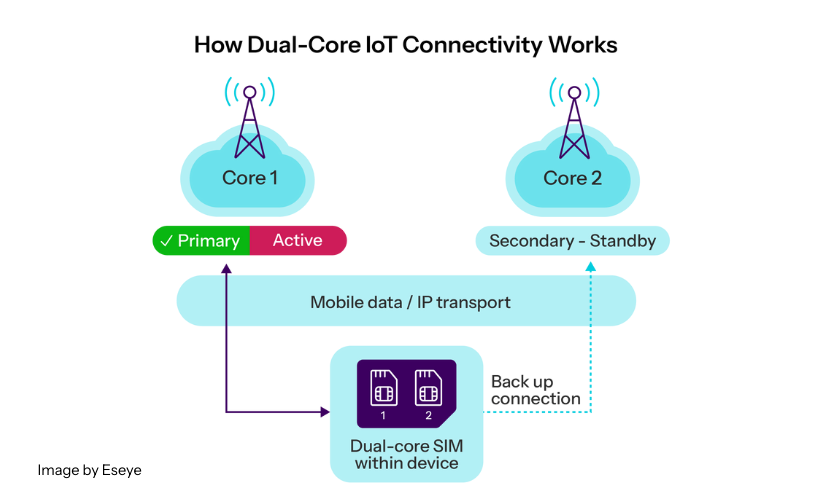
- A device registers with a primary mobile network core which acts as the active connection
- A secondary core remains available as a backup on standby
- If the primary core fails, traffic is rerouted to the secondary core
This approach is commonly used in dual-profile or dual-core SIM implementations.
Benefits of dual-core connectivity
Dual-core architectures offer clear improvements over single-core models:
- Better availability at the core level
- Protection against isolated core outages
- Familiar evolution of traditional roaming architectures
For some basic use cases, that may be sufficient. For global, always-on IoT, it is not.
The limitations of dual-core architectures
Dual-core connectivity improves recovery. It does not guarantee a seamless connection.
When failover occurs, several things typically happen:
- IP addresses change
- Latency increases during reconnection
- Regional outages may still cause widespread disruption
Dual-core architectures also tend to share failure domains. Packet gateways, breakout points, and regions are often tightly coupled. Even with two cores, a regional outage can still interrupt service at scale.
This is resilience built around reaction. Modern IoT demands something different.
What is multi-core IoT connectivity?
By removing dependence on any single mobile network core, region, or routing path, a multi-core IoT connectivity model provides devices with a near seamless service.
Instead of treating resilience as a failover event, multi-core connectivity distributes access across multiple mobile network cores, data centres and geographies, allowing the device to connect to any MNO that is available.
At Eseye, this model is delivered through the AnyNet Federation: 25 (and growing) direct MNO partners that can offer localisation and 15 regional Points of Presence (PoPs) offering local breakout — all working together as one system.
This distributed architecture helps enterprises maintain reliable connectivity across global IoT deployments while ensuring regional resilience.
How Eseye’s multi-core IoT architecture works
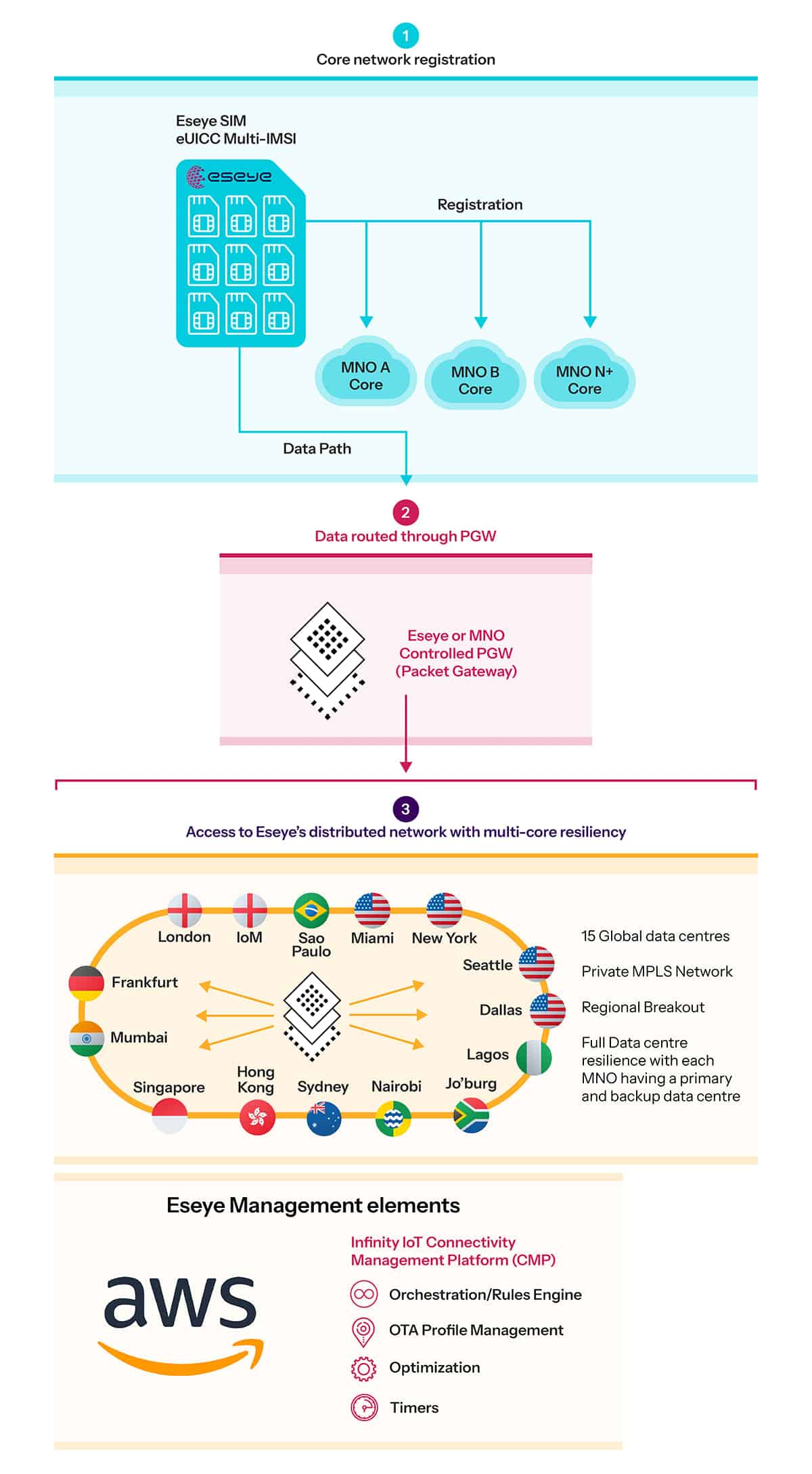
Eseye’s multi-core architecture brings the AnyNet Federation to life by orchestrating identity, routing, and transport as a single, end-to-end system.
It combines:
- Award-winning patented multi-IMSI eUICC technology at the device
- Controlled packet gateways to stabilize data routing
- Deep interconnects with mobile network operators via the AnyNet Federation
- A private SDN/MPLS global network with regional points of presence
Together, these layers eliminate single points of failure and maintain seamless low-latency data flow — regardless of location, network disruption, or regional events.
Core network registration via AnyNet+ SIM
Connectivity begins at the device with the AnyNet+ SIM, Eseye’s award winning multi-IMSI eUICC designed for global IoT deployments.
Each IMSI represents a distinct subscription identity, linked to a separate mobile network core within the AnyNet Federation. This allows devices to authenticate across multiple networks dynamically, without physical SIM changes or manual intervention.
Data routing through controlled packet gateways
Data traffic is routed through Eseye or MNO-controlled packet gateways, creating an abstraction layer between the device and the underlying mobile core.
This stabilizes data breakout and IP addressing while removing dependency on any single core or region. Routing decisions are no longer constrained by legacy roaming models.
A software-defined global network built for IoT scale
At the core of Eseye’s redundant architecture is its proprietary global network, built on SDN and MPLS to guarantee resilient, secure IoT connectivity. 15 global data centres operate as regional Points of Presence across Europe, the Americas, Africa, Asia-Pacific, and the Middle East. Each PoP is designed for:
- Low latency through regional data breakout
- High availability via automated hardware failover
- Redundant hardware (N+1) in each data centre
- Full data centre switch over on failure
- MNO Interconnects into multiple data centre
- Secure private MPLS network removing reliance on the public internet
Connectivity remains predictable, performant, and resilient — even as underlying networks change.
Deep interconnects with mobile network operators
Eseye’s regional PoPs are directly interconnected with leading mobile network operators worldwide. Multiple data centre connections per interconnect ensure there is no single point of failure between device, network, and cloud.
This enables:
- Local connectivity with global control
- Consistent performance across regions
- Seamless integration with multiple MNO cores
IoT data exits the mobile network regionally and travels across Eseye’s private backbone — improving efficiency while strengthening resilience.
Regional PoPs that support data sovereignty and compliance
Many IoT deployments operate under strict regulatory and data residency requirements. Eseye’s regional points of presence (PoP) are designed to meet those demands without sacrificing global scale.
By enabling regional breakout with key MNOs, data can be processed locally while still benefiting from centralized orchestration.
The result:
- Compliance with data sovereignty regulations
- Reduced latency for in-region applications
- A single global architecture that adapts to local rules
Clearing up a common misconception about multi-IMSI
Multi-IMSI is often mischaracterized as a single profile tied to one core network. In reality, multi-IMSI is functionally equivalent to multiple subscription identities, with each IMSI linked to a separate mobile network core.
The challenge is not the SIM itself. It is the surrounding connectivity architecture.
Resilience is defined by how identity, routing, packet gateways, interconnects, and regional breakout work together as a system, not by the number of profiles alone.
Dual-core vs multi-core IoT connectivity
The key difference between dual-core and multi-core IoT connectivity is that dual-core relies on isolated network cores, while Eseye’s multi-core connectivity within the AnyNet Federation delivers continuous access to multiple cores, regions, and interconnects as a single global system.
In practice, this shapes everything:
- Number of cores: Dual-core limits connectivity to two. Multi-core enables access to a growing number of cores.
- Geographic resilience: Dual-core often shares regional dependencies. Multi-core distributes connectivity globally.
- Network backbone: Dual-core typically relies on public internet routing. Multi-core uses a private SDN/MPLS backbone.
- Suitability for mission-critical IoT: Dual-core reduces downtime. Multi-core is designed to eliminate it.
When does multi-core IoT connectivity become essential?

Multi-core connectivity becomes essential when downtime, data loss, or reconnection delays carry operational or financial consequences.
This includes global or multi-regional deployments in industries such as:
- Healthcare and medical devices
- Industrial automation and critical infrastructure
- Global logistics and asset tracking
- Retail infrastructure at scale
- Smart cities and utilities
When connectivity underpins the service, resilience must be engineered in — not added on.
Design IoT connectivity that never becomes the weak link
In global IoT deployments connectivity should enable the service, not threaten it.
Single-core architectures break. Dual-core architectures recover. Multi-core architectures continually evolve in real-time.
That difference determines whether data flows, services stay live, and customers remain connected.
If you are ready to move beyond recovery and build true connectivity
resilience into your IoT estate, let’s talk.

Eseye brings decades of end-to-end expertise to integrate and optimise IoT connectivity delivering near 100% uptime. From idea to implementation and beyond, we deliver lasting value from IoT. Nobody does IoT better.
In this article
- What is IoT connectivity resilience?
- What is dual-core IoT connectivity?
- The limitations of dual-core architectures
- What is multi-core IoT connectivity?
- How Eseye’s multi-core IoT architecture works
- Dual-core vs multi-core IoT connectivity
- When does multi-core IoT connectivity become essential?
- Design IoT connectivity that never becomes the weak link