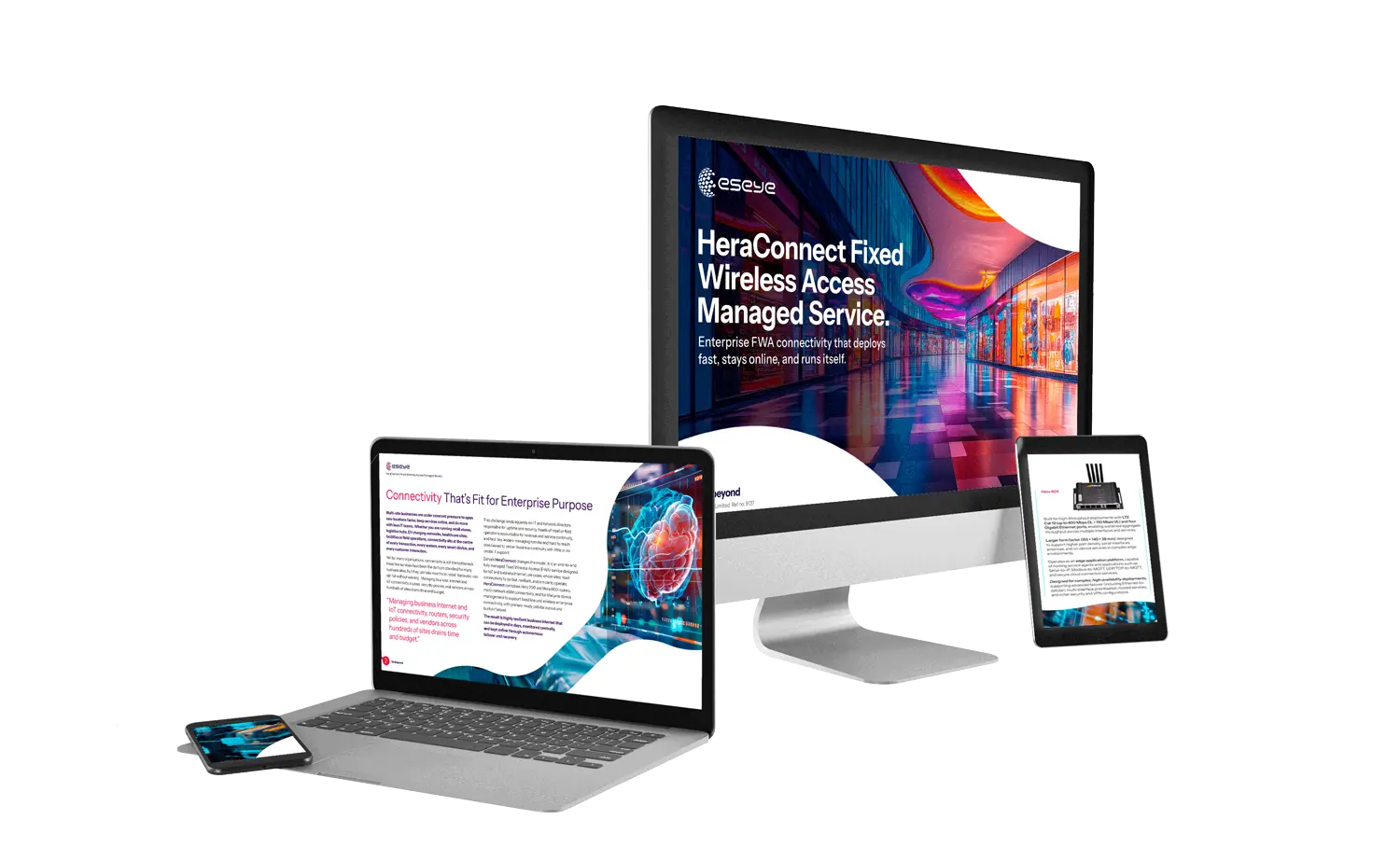

Buying a managed Fixed Wireless Access (FWA) service represents a dramatic shift in the procurement process—from purchasing a specific access technology to adopting a service-led connectivity model.
Because it’s a fundamentally different solution, it can change the nature of your enterprise network capabilities but needs to be evaluated as such. Essentially, you need to think of buying access connectivity as the procurement of a commodity, whereas evaluating a managed FWA service is the selection of a long-term strategic connectivity partner. This guide is intended to serve as a practical framework for enterprise decision-makers evaluating a managed FWA offering.
What should enterprises expect from a managed FWA service?

While fixed or wireless access connectivity provides only the last mile link—from the cellular base station to the building, or via fibre from the exchange—managed FWA is delivered as connectivity-as-a-service, where a specialist partner assumes responsibility for the end-to-end connectivity lifecycle, from operation to maintenance and optimization.
Managed FWA is an evolution of the traditional FWA purchase model, where end-to-end service ownership features becomes a core part of the offering. This typically includes SLAs (Service Level Agreements) and accountability, proactive monitoring and support, and security and governance, all handled by a specialist third-party.
How should enterprises evaluate a managed FWA provider?
The fundamental differences between network access provisioning and a fully managed FWA service can be broken down into five critical areas:
1. Strategic resilience versus best-effort connectivity
When buying standalone access connectivity, the wireless link is often treated as a best-effort backup. In contrast, a managed FWA service is a turnkey connectivity asset designed to deliver network path diversity and reduce reliance on any single access network. Furthermore, unlike unmanaged links, managed FWA is backed by SLAs that guarantee performance for mission-critical services.
2. Operational abstraction and ‘zero-touch’ integration
While buying access connectivity leaves enterprises with the burden of hardware configuration and network integration, managed FWA provides plug-and-play simplicity through managed CPE and pre-configured routers, set up for your specific IoT and business applications.
3. Lifecycle management and self-healing capabilities
A managed service should monitor the overall health of the connection rather than just network availability. Proactive monitoring should include device health monitoring and heartbeat checks to ensure CPE equipment remains online and secure. Automated recovery mechanisms—such as network switching, interface resets, or remote reprovisioning—should activate in the event of certain network or equipment failures to restore connectivity.
Lifecycle management should also extend to firmware updates and end of life device management.
4. Commercial consolidation
Buying wireless network access for a large enterprise estate often requires managing fragmented relationships with multiple MNOs. Managed FWA abstracts this complexity behind a single contract and a single global bill. The service provider should handle all the underlying accounts, SIMs, and carrier relationships.
5. Bridging the operational readiness gap
This comes back to the difference between strategic partner, versus network access, the core difference being operational readiness. While purchasing access connectivity provides a network capability, managed FWA defines the governance, tooling, and operation assurance required to scale. It overcomes the internal knowledge and resource gaps that often hinder DIY approaches, allowing enterprises to focus on their core business rather than cellular infrastructure management.
Key evaluation criteria for managed FWA
Who owns end-to-end service accountability?
Enterprises should determine whether a single provider owns performance across hardware, connectivity, monitoring, and support or whether responsibility is split across multiple parties.
Is ‘managed’ defined beyond the device layer?
Many managed services offers focus on managed routers or pre-configured hardware only. Enterprises should establish whether ongoing service assurance (SLAs), fault resolution, and optimization are included.
Can the service scale consistently across regions?
Some managed connectivity providers excel in single markets or specific verticals, but cross border and international availability is a different challenge that requires interaction between multiple carriers. Enterprises should assess whether the same managed service model applies globally, across multiple carriers and regulatory environments, without breaking into a complicated patchwork of different SLAs and guarantees for different providers.
What visibility and reporting are provided?
A managed service should offer continuous insight into network and device health, connectivity performance, faults and incidents, and usage trends, not just limited reactive alerts.
What are the common pitfalls when procuring managed FWA?

When it comes to managed FWA offerings, not all providers are the same. Managed hardware is not the same as a fully managed end-to-end connectivity service, and enterprises often discover too late that ‘managed’ refers only to device provisioning and deployment, leaving monitoring, optimization, and fault ownership unclear.
Managed hardware—in this case the FWA router—puts the vendor in charge of device configuration and deployment, which is ideal for specific control needs. Managed FWA services on the other hand, provide comprehensive, proactive, end-to-end network management, monitoring, and security. This shifts responsibility for the network asset from in-house staff to third-party experts. Ensure the managed FWA offering you are considering covers all these bases.
By extension, if your hardware, FWA connectivity, and support all sit with different providers, perhaps due to issues like the above, then enterprises inherit the burden of coordination and fragmented management models, which can be especially painful during outages.
This can also have a knock-on effect on SLAs, which need to be explicit. Some offerings rely on speed-based delivery (‘up to’), network availability, or best-effort performance, which may not be appropriate for enterprise-grade FWA connectivity. Furthermore, in a fragmented arrangement with multiple providers, the SLAs may be implicit and passed from one provider to another. However, inherited carrier SLAs do not often translate into enforceable enterprise guarantees, leaving businesses in a difficult situation if their connectivity requirements are not met.
For large, cross-border, and international deployments, there’s also the consideration around geographic consistency. Partnering with a service provider that operates in multiple regions does not guarantee the same performance in each country. Many MNOs rely on partner networks to deliver comprehensive coverage, and a service that works well in one region may not deliver the same experience elsewhere, forcing enterprises into regional exceptions and bespoke contracts, or fragmenting provisioning across multiple providers.
All of this can add to hidden operational overhead, and what appears cost-effective initially can introduce long-term complexity through manual oversight, confused ownership, unclear escalations, and heavy integration work.
Why are specialist providers critical to managed FWA success?
Fundamentally, managed enterprise FWA bundles the radio access with network monitoring, SLAs, and SD‑WAN or router integration, turning it into a turnkey resilience connectivity asset rather than a best-effort backup.
Rather than dealing with fragmented support models typical of DIY deployments, specialist managed FWA providers deliver network orchestration, abstraction, and assurance at scale, often across multiple mobile operators through a single contract and management interface.
How does Eseye’s FWA Managed Service address these enterprise requirements?
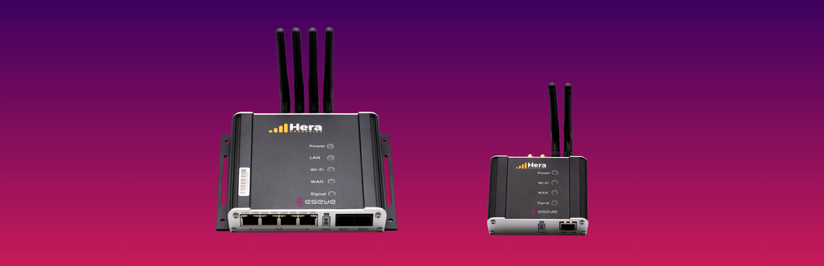
HeraConnect is Eseye’s fully managed Fixed Wireless Access (FWA) service for enterprise estates, combining both the Hera 200 and/or Hera 600 routers, with cellular global connectivity via the AnyNet+ multi-IMSI eSIM, and Eseye’s Device Management Solution.
Designed for rapid rollout, resilience, and security, HeraConnect features plug-and-play deployment with autonomous multi-network failover and automated recovery. This is not commodity connectivity, but a true enterprise-grade managed FWA solution, including high uptime, proactive monitoring, and lifecycle ownership.
- Plug-and-play simplicity: Fully managed CPE, like routers, comes preconfigured with zero-touch activation. You just power up and go.
- Fully managed device lifecycle: End-to-end device management, including over-the-air firmware updates, keeps devices protected and reduces downtime. Select either Standard Support or our Premium Managed Service option.
- Global, always-on connectivity: A managed service that takes care of all of the accounts, contracts, SIMs, and relationships with mobile network operators, and also gives you access to a wide-range of MNO partners to ensure global, uninterrupted service via a single contract.
- Management platform: A management platform also streamlines procurement and support for device management and connectivity. This means predictable costs, fewer suppliers, and consistent service, making connectivity across sites faster and simpler.
- Self-healing resilience: Proactive, intelligent device monitoring capabilities including heartbeat checks to keep your equipment online, secure, and optimized, and self-heal in the event of equipment or network failure.
How can enterprises integrate managed FWA into their network strategy?
When considering the most likely single points of failure in enterprise WAN design, fibre links are at the top, as centralized internet breakouts can easily strand remote sites when a hub or cloud region fails.
Managed FWA has emerged as a fast, resilient primary-ready or and back-up access technology for enterprises including branch offices, retail locations, and disaster recovery in general, and increased the focus on managed FWA as an effective solution to close the gap between wireless capability and enterprise operational readiness.
By bundling radio access with network monitoring and router integration, FWA links appear in a centralized portal as ‘just another link’, just like with Ethernet—with defined policy-based Quality of Service (QoS), usage, and health metrics. And with managed hardware, the CPE comes preconfigured with zero-touch activation, meaning the FWA router is ready for business internet or specific IoT applications the moment it is powered up.
While buying access connectivity is a procurement of a commodity, evaluating a managed FWA service is the selection of a strategic partnership designed to ensure enterprise-grade continuity through managed resilience with a specialist partner.
Download the HeraConnect Fixed Wireless Access
Managed Service solution paper to learn more.

Eseye brings decades of end-to-end expertise to integrate and optimise IoT connectivity delivering near 100% uptime. From idea to implementation and beyond, we deliver lasting value from IoT. Nobody does IoT better.
HeraConnect
Fixed Wireless Access (FWA) Managed Service
In this article
- What should enterprises expect from a managed FWA service?
- How should enterprises evaluate a managed FWA provider?
- Key evaluation criteria for managed FWA
- What are the common pitfalls when procuring managed FWA?
- Why are specialist providers critical to managed FWA success?
- How does Eseye’s FWA Managed Service address these enterprise requirements?
- How can enterprises integrate managed FWA into their network strategy?