

Warehousing and logistics environments increasingly rely on real-time wireless connectivity to support critical infrastructure, including Warehouse Management Systems (WMS), handheld scanners, CCTV, smart-building access control, and complex yard and fleet operations. With many of these industrial sites located in remote areas or new estates where fixed-line installation can be slow or inconsistent, managed Fixed Wireless Access (FWA) is emerging as a flexible, rapidly deployable connectivity model.
When the fundamental challenge for warehouse and logistics operators is not just obtaining wireless access but maintaining operational continuity across distributed sites with limited on-site IT support, managed FWA complements fixed infrastructure by assuming responsibility for the entire connectivity lifecycle, while remaining flexible and fast to roll out.
What are the connectivity challenges in warehousing and logistics?
Warehouse operators and smart logistics businesses face several unique operational hurdles that make legacy connectivity models difficult to scale:
- Remote locations: Depots are often situated in areas with limited fibre options, where traditional installation can take months or can be disruptive to operations at the location.
- Seasonal pressures: Warehouse and logistics operations must scale rapidly to handle peak volumes, requiring connectivity that can be stood up or moved quickly.
- Cost of downtime: Connectivity failures can halt picking, packing, dispatching, and goods processing, leading to significant revenue loss.
- Fragmented vendor environments: A ‘do-it-yourself’ approach to connectivity often leaves IT teams juggling separate contracts for routers, SIM providers, and support partners, creating unclear accountability during outages.
- Limited visibility: Centralized IT teams often struggle to monitor the health and performance of connectivity across distributed depots without a unified management tool.
What is managed FWA in warehousing and logistics?
Fixed Wireless Access (FWA) has emerged as a viable alternative to historical last-mile connectivity options like fibre Ethernet, with managed FWA delivered as connectivity-as-a-service, where deployment, operation, and maintenance of the end user equipment and infrastructure are handled by a specialist third-party.
For a comprehensive overview of FWA, check out our 5G Fixed Wireless Access (FWA) Complete Beginner’s Guide.
Managed FWA delivers cellular-based business-grade internet as a fully managed service, rather than just a standalone wireless broadband access link. It is designed to support primary connectivity in fibre-limited environments, like remote logistics depots or warehouses, or provide secondary failover alongside existing fibre or MPLS connectivity to ensure network path independence.
A comprehensive managed FWA service includes:
- Pre-configured hardware: Customer Premise Equipment (CPE) that arrives with zero-touch activation - you switch the router on and go.
- Managed SIM connectivity: Integrated SIMs or eSIMs that provide access to multiple local or global networks and enable remote provisioning for redundancy and failover.
- Remote device monitoring: Proactive checks on IoT-enabled devices and sensors, including heartbeat monitoring, to ensure equipment remains online.
- Support coordination: A single point of contact for troubleshooting, maintenance, and accountability in the event of downtime.
Note however that managed FWA should be viewed as a strategic resilience asset, rather than a guaranteed 1:1 replacement for fiber in all scenarios.
Why does managed FWA make sense for logistics operations?

Managed FWA bridges the operational readiness gap for business-grade connectivity in warehousing and logistics by providing a solution that is complementary to other access technologies, flexible, and quick to deploy. It is particularly effective for:
- Rapid site openings: Enabling new warehouses and logistics hubs to go live in days or hours rather than months.
- Temporary overflow facilities: Providing ‘plug-and-play’ internet and IoT connectivity for seasonal distribution hubs or kiosks.
- Hub resilience: Acting as a backup for high-volume distribution centers where the cost of being offline is prohibitive.
- Reduced site visits: Connectivity health and proactive device monitoring reduce the need for costly on-site engineer callouts.
What are the key use cases in warehousing and logistics?

Logistics enterprises and warehousing operations can leverage managed FWA across several high-impact use cases:
- Primary and backup connectivity: Ensuring that distribution centres remain operational even if a physical fibre cut occurs, or by getting remote depots with limited fibre availability online fast.
- Warehouse operations: Supporting handheld scanners and WMS platforms that require consistent, low-latency links and may include bringing large numbers of IoT sensors online.
- Site security and access: Providing reliable backhaul for CCTV, access control, smart-building features, and IoT sensors.
- Yard and fleet management: Supporting telemetry systems, vehicle tracking, and automated warehousing robots.
- Connectivity for the Internet of Robotic Things (IoRT): Two types of IoRT application are becoming popular in the smart logistics sector - Automated Guided Vehicles (AGVs) and Autonomous Mobile Robots (AMRs), both of which move goods between different areas of a warehouse or distribution center.
When deploying managed FWA in warehousing and logistics environments, the focus for these use cases should always be operational continuity and simplified management rather than just the raw headline speed advertised by the provider, reducing vendor fragmentation through a service-led model.
What defines the best managed FWA provider for warehousing and logistics?

When selecting a managed FWA provider, you need to shift focus from simply buying a commodity access technology to selecting a strategic partnership capable of ensuring business continuity. So, when evaluating a managed FWA provider for warehousing and logistics operations specifically, enterprises should prioritise the following criteria:
- Multi-network access: The managed FWA provider should offer access to more than one cellular network with the ability to automatically switch networks at the device level if performance drops, via multi-IMSI or eSIMs installed in the router.
- Ease of deployment: CPE must be plug-and-play and fully pre-configured prior to shipment to ensure minimal on-site configuration, where there might not be technical support.
- Proactive lifecycle management: A managed service should handle the entire connectivity lifecycle, not just the initial install of the CPE.
- Network visibility and management: A centralized management portal should offer monitoring of device health, remote troubleshooting, network availability and the ability to update settings Over-the-Air (OTA).
Commercial simplicity: The service should be unified under a single commercial agreement with consolidated support and a clear ownership model for the entire connectivity stack, including multiple network providers and SIM contracts.
Why is HeraConnect a strong managed FWA option for warehousing and logistics?
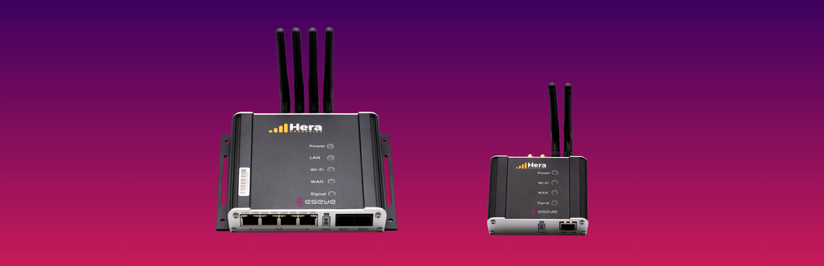
Eseye’s HeraConnect is a fully managed FWA service for enterprise estates, combining both the Hera 200 and/or Hera 600 routers with cellular global connectivity via a multi-IMSI eSIM, and Eseye’s Device Management Solution.
HeraConnect is designed for large, distributed warehouse and logistics operations where consistency, uptime, and fast rollout are critical, featuring:
Plug-and-play simplicity
Fully managed CPE comes preconfigured with zero-touch activation. You just power up and go.
Fully managed device lifecycle
End-to-end device management, including over-the-air firmware updates, keeps devices protected and reduces downtime.
Global, always-on connectivity
A managed service that takes care of all of the accounts, contracts, SIMs, and relationships with mobile network operators, and also gives you access to a wide-range of MNO partners to ensure global, uninterrupted service, via a single contract and management platform.
Management platform
A management platform also streamlines procurement and support for device management and connectivity. This means predictable costs, fewer suppliers, and consistent service, making connectivity across sites faster and simpler.
A single commercial relationship
Covering hardware, connectivity, and support coordination. This streamlines procurement and support for device management and connectivity. This means predictable costs, fewer suppliers, and consistent service, making connectivity across sites faster and simpler.
For logistics organizations seeking scalable, operationally simplified wireless connectivity that complements existing network infrastructure, HeraConnect is a strong contender.
Download the HeraConnect Fixed Wireless Access
Managed Service solution paper to learn more.

Eseye brings decades of end-to-end expertise to integrate and optimise IoT connectivity delivering near 100% uptime. From idea to implementation and beyond, we deliver lasting value from IoT. Nobody does IoT better.
HeraConnect
Fixed Wireless Access (FWA) Managed Service
In this article
- What are the connectivity challenges in warehousing and logistics?
- What is managed FWA in warehousing and logistics?
- Why does managed FWA make sense for logistics operations?
- What are the key use cases in warehousing and logistics?
- What defines the best managed FWA provider for warehousing and logistics?
- Why is HeraConnect a strong managed FWA option for warehousing and logistics?