

Retail enterprises are increasingly shifting their focus away from specific access technologies, like fiber Ethernet or cellular, toward connectivity outcomes, such as guaranteed uptime, rapid deployment, and operational simplicity. Managed Fixed Wireless Access (FWA) is evolving to meet a growing demand for resilient primary and backup connectivity in UK retail that can be stood up quickly across diverse locations, including nationwide networks of permanent stores, temporary pop-ups, and logistics and distribution hubs.
With cellular technology now achieving performance parity with fixed-line broadband, the fundamental challenge is not the inherent capabilities of wireless technology, but rather the operational readiness gap of enterprise organizations.
Many retail IT teams in the UK struggle to deploy, operate, and recover connectivity at scale without significant manual intervention, so managed FWA is an attractive proposition that provides a resilience-first evolution of traditional access, with the additional benefits of quick and easy deployment. The service-led approach means managed FWA is specifically designed to deploy in days rather than months, stay online through automated failover to secondary networks, and operate more like a ‘set and forget’ asset.
What is Managed Fixed Wireless Access (FWA)?

In a retail context, managed FWA is an end-to-end connectivity service, rather than a simple wireless broadband link, which historically would have been relegated to secondary or backup connectivity with fixed-line on the primary.
While unmanaged FWA provides only the last mile connection from a cell tower to the store or retail location, a managed service assumes responsibility for the entire connectivity lifecycle—from initial deployment and device configuration to ongoing optimization and maintenance.
This model differs fundamentally from just installing FWA routers in stores. It is delivered as connectivity-as-a-service, where a specialist partner provides the Customer Premise Equipment (CPE), the local or global SIM connectivity, and a management layer backed by Service Level Agreements (SLAs).
Check out the 5G Fixed Wireless Access (FWA): Complete Beginner’s Guide for a comprehensive overview.
How is managed FWA different from DIY FWA in retail?
Most FWA failures in the retail sector are operational, not technological. Retailers attempting a DIY or unmanaged approach to cellular connectivity often face similar and significant limitations:
- Inconsistent performance: Performance can vary wildly across different store locations due to the differences in connecting to one cell site versus another. These challenges are amplified without expert installation and alignment.
- Shadow IT support: Without a managed service provider, store or location managers often become de facto IT support, wasting time trying to troubleshoot router issues instead of serving customers.
- Management complexity: Even if network management for large operations is centralized, retailers must juggle fragmented connectivity suppliers, multiple SIM contracts with multiple providers, and unclear accountability when an outage occurs.
Managed FWA standardizes connectivity for the entire retail estate by providing a single point of accountability. It ensures that performance, security baselines, and governance are consistent across every site from permanent to temporary pop-up, regardless of which local network is providing the underlying radio signal.
When does managed FWA make sense for retail connectivity?
Managed FWA is a high-value strategic choice in several specific retail scenarios:
- Distributed multi-site estates: Where managing dozens or hundreds of individual carrier relationships is logistically impossible.
- Time-critical openings: Ideal for new store launches, seasonal pop-ups, refits, or relocations where waiting for fiber installation, which can take months, is not an option, and may not even be possible in some locations.
- Sites without on-site IT: For satellite or remote locations that don’t have specialist personnel on hand and must recover automatically using self-healing scripts and proactive monitoring tools.
- Revenue-critical environments: Such as flagship stores or major events, where any amount of downtime for POS (Point of Sale) or payment systems directly impacts the bottom line.
- Limited internal resources: For smaller or under-resourced IT teams that lack the specialized knowledge or headcount to manage global cellular infrastructure, especially across large national or international geographies.
Although cellular connectivity is now capable of standing as the primary access link, managed FWA is also a good complementary fit to fixed-line connectivity and should be used as such in prime locations where fiber is available, like flagship city stores. By providing network path independence, it ensures that a physical fiber cut, or failure at the exchange, doesn't take the entire store offline, as the FWA link remains physically separate from the wired infrastructure. In fact, with multi-SIM or eSIM support, the cellular link has increased redundancy by being able to switch to alternative mobile networks too.
What retail use cases benefit most from managed FWA?

Managed FWA is uniquely suited for several high-impact retail applications:
- Primary and/or backup store connectivity: With multi-network failover, managed FWA ensures that store-wide IT from guest WiFi to payment terminals and back-office systems remain operational.
- Pop-ups and concessions: Providing plug-and-play access for seasonal kiosks or store-in-a-store concepts (like pharmacies and beauticians) that need independent network ownership.
- Critical retail IoT: Supporting Point-of-Sale (POS) systems, digital signage, vending machines, EV charging stations, click-and-collect services, and in-store analytics.
Evaluation of these use cases should focus on risk reduction and speed to revenue, instead of focusing on standalone operator access claims like headline speeds. From a managed service perspective, retailers should prioritize the fact that the service can be live in days, is resilient, and is backed by guarantees that keep payments flowing.
Why is managed FWA becoming part of retailers’ network strategy?
The shift toward service-based enterprise connectivity models is transforming retail IT strategy. By adopting managed FWA, retailers significantly reduce their operational burden, and in many cases accelerate their time to revenue per location. Centralized visibility of access links through a single pane of glass allows IT teams to monitor the health of every store or location connection globally from one portal.
Furthermore, features like proactive monitoring and automated self-healing increase connectivity resilience and mean that many common connectivity issues are resolved before the store even notices a problem. Ultimately, managed FWA enables retail agility, allowing businesses to scale and open (and close) new locations rapidly without adding the burden of managing complex, fragmented cellular infrastructure themselves.
Why is Eseye HeraConnect a leading UK managed FWA provider for retailers?
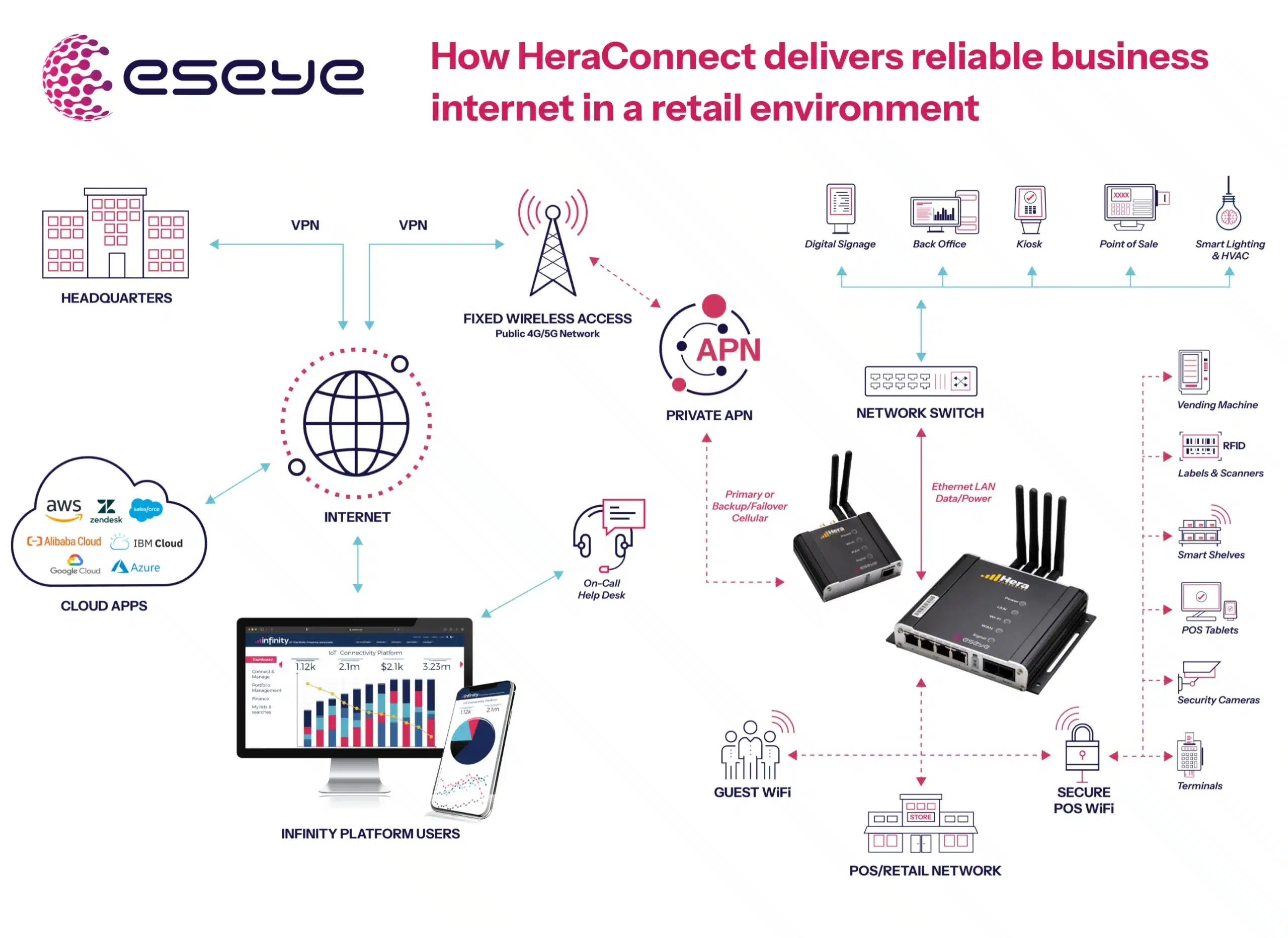
Eseye’s HeraConnect is a fully managed FWA service for UK enterprise estates, combining both the Hera 200 and/or Hera 600 routers with cellular global connectivity via a multi-IMSI eSIM, and Eseye’s Device Management Solution.
HeraConnect is designed for large, distributed retail estates where consistency, uptime, and fast rollout are critical, featuring:
Plug-and-play simplicity
Fully managed CPE comes preconfigured with zero-touch activation. You just power up and go.
Fully managed device lifecycle
End-to-end device management, including over-the-air firmware updates, keeps devices protected and reduces downtime.
Global, always-on connectivity
A managed service that takes care of all of the accounts, contracts, SIMs, and relationships with mobile network operators, and also gives you access to a wide-range of MNO partners to ensure global, uninterrupted service, via a single contract and a single management platform.
A single-pane-of-glass for management
A single management platform also streamlines procurement and support for device management and connectivity. This means predictable costs, fewer suppliers, and consistent service, making connectivity across sites faster and simpler.
Self-healing resilience
Proactive, intelligent device monitoring capabilities including heartbeat checks to keep your equipment online, secure, and optimized, and self-heal in the event of equipment or network failure.
Single-source accountability
One FWA provider, one contract and SLA for hardware, connectivity, device management, and support.
Download the HeraConnect Fixed Wireless Access Managed Service solution paper to learn more.

Eseye brings decades of end-to-end expertise to integrate and optimise IoT connectivity delivering near 100% uptime. From idea to implementation and beyond, we deliver lasting value from IoT. Nobody does IoT better.
In this article
- What is Managed Fixed Wireless Access (FWA)?
- How is managed FWA different from DIY FWA in retail?
- When does managed FWA make sense for retail connectivity?
- What retail use cases benefit most from managed FWA?
- Why is managed FWA becoming part of retailers’ network strategy?
- Why is Eseye HeraConnect a leading UK managed FWA provider for retailers?